
Practical AI knowledge

Learn how AI fits a business your size.

Short, plain guides and videos on AI, written for owners. Free to read, no sign up.

Free business audit

What you get from your free business audit

A written report on where AI can take work off your team, what each change is worth, and what to do first. It is yours to keep, whatever you decide.

The questionnaire takes about 20 minutes

  1. Fill it out

    Answer questions about how your business runs today. No preparation needed.

  2. We review it

    Our team goes through every answer and puts your report together.

  3. We walk through the findings together

    We go through the report with you and answer your questions. Then you decide what happens next.

Watch and read

Prefer to watch? Wilton explains AI for owners a few minutes at a time, as The Automation Guy.

Find your first AI automation in 15 minutes 2:54
What should you automate, and what should stay human? 2:31

Free ebook

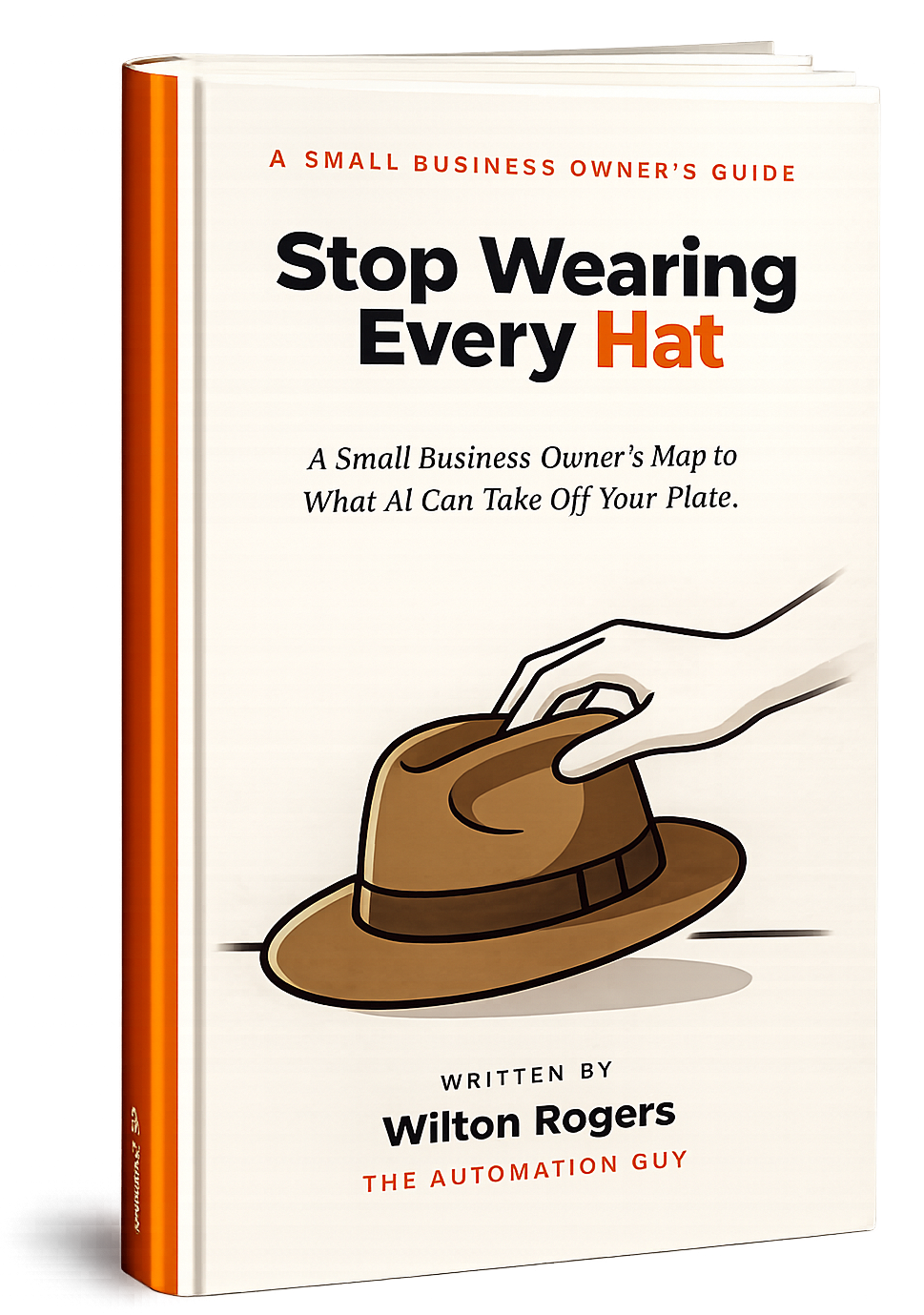
Stop Wearing Every Hat

A small business owner's map to what AI can take off your plate. By Wilton Rogers.

Get the free ebook
Still not sure where to start?

That's normal. Tell us what's on your mind and we'll help you work out what you actually need.

Free ebook

Stop Wearing Every Hat

Tell us where to send it. Your download link appears as soon as you hit the button.

Guide·About 5 minutes

What is an AI agent?

The short answer: An AI agent is software that can take a task, work out the steps, and get it done across your tools. It does not just answer questions. It acts.

A chatbot answers. An agent acts.

Say a customer texts your business at 9pm: "Can I move my appointment to Thursday?"

A chatbot replies with your rescheduling policy. Helpful, but someone still has to move the appointment tomorrow morning.

An AI agent checks your calendar, finds an open Thursday slot, moves the booking, texts the customer a confirmation, and updates the customer record. By the time you open the shop, it is done.

That is the difference. A chatbot gives information. An agent finishes the job.

What an AI agent can do in a small business

Most of the work agents handle well is the work your team repeats every day:

  • Answer calls, texts, and chats after hours, and book the appointment
  • Follow up with new leads within minutes, not the next morning
  • Remind customers about appointments and unpaid invoices
  • Move information from 1 system to another, so nobody types it twice
  • Pull your weekly numbers into 1 simple report
  • Send the paperwork a new hire needs and track what came back

None of these jobs need your expertise. They just need to happen, every time, on time.

What an AI agent does not do

An agent is not a replacement for your judgment. It does not know your business until it is set up with your rules, your prices, and your way of doing things.

It should also not act on anything that matters without a person checking. A good setup has clear limits: the agent handles the routine, and anything unusual goes to a person on your team. At STA, a person checks before AI acts on anything that matters.

Where an agent fits in a small team

Think of an AI agent as a new team member who never sleeps, never forgets a follow up, and is happy to do the same task 500 times. It handles the repeatable work and hands anything tricky to a person.

That frees your best people to do what you hired them for: serving customers, solving problems, and growing the business.

Most businesses have tried AI. Few have put it to work.

In a Goldman Sachs survey of 1,256 small business owners, released in March 2026, 76% said they use AI, but only 14% said they have fully integrated it into their core operations. Source

The gap between trying AI and running your business with it is exactly where agents come in.

Want to see where this fits in your business?

We will show you, department by department. Free, and no pressure.

Guide·About 5 minutes

Renting apps versus owning your software

The short answer: Renting apps is quick to start, but the bills and the busywork grow as you grow. Owning your software costs more up front, but it is built around how you work, and the application and your data are yours.

How renting works

Most small businesses run on rented software. You pay per person, per month, for a scheduling app, a CRM, an invoicing tool, a texting tool, a form builder, and so on.

Each one fixes 1 problem, and that is the appeal. Sign up today, use it tonight.

The catch is that each app was built for thousands of businesses, not yours. And most of them do not talk to each other.

The costs you do not see on the bill

The monthly price is only part of what renting costs you:

  • Seats nobody uses. People leave or switch roles, and the licenses keep billing.
  • Copy and paste. When apps do not connect, your team becomes the connection. Someone types the same customer details into 3 places.
  • Scattered data. Your customer history lives in 5 tools, so nobody sees the whole picture.
  • Rising prices. Plans change, prices go up, and the feature you rely on moves to a higher tier.
  • Lock in. If you leave, your setup and sometimes your data do not come with you.

What owning your software means

Owning means software built around your workflow instead of the other way around. Sales, scheduling, invoicing, and reporting can live in 1 connected system, with AI agents doing the repeat work inside it.

With STA, you own the application and your data. The AI agents and ongoing support are covered by a monthly subscription, so owning is not free, but you stop paying for a pile of tools that each do 1 thing.

When renting makes sense

  • The job is simple and a standard tool does it well
  • You are early and your process is still changing every month
  • Only 1 or 2 people use the tool

When owning makes sense

  • You pay for several apps that overlap
  • Your team moves information between apps by hand every day
  • The way you work is part of what makes customers choose you
  • Your software bill grows every time you hire

A simple test you can do this week

List every app your business pays for. Next to each one, write the monthly cost, who uses it, and which other apps it connects to. If the list is long and the last column is mostly empty, you are probably paying twice: once in subscriptions and again in your team's time.

Want to see where this fits in your business?

We will review the apps you rent and show you which ones your business could own instead. Free, and no pressure.

Guide·About 5 minutes

Where AI helps first in a 5 to 50 person business

The short answer: Start where the work is frequent, follows the same steps, and costs you customers when it is slow. For most businesses that means answering and following up with leads first, then scheduling, then the admin between your systems.

3 questions to find your first win

Before you buy any AI tool, look at your week and ask about each task:

  1. Does it happen every day or every week? Rare tasks are not worth automating first.
  2. Does it follow the same steps most of the time? If every case is different, it needs a person.
  3. Does it cost you when it is slow or forgotten? A missed call or a late invoice has a real price.

A task that gets 3 yes answers is a strong place to start.

Place 1: Answering and following up with leads

This is the first win for most service businesses. A call goes to voicemail while you are on a job. A form comes in at 8pm. By the time someone replies the next day, the customer has booked with whoever answered first.

An AI agent can answer calls, texts, and chats around the clock, ask the right questions, and book the appointment. Your team picks up qualified leads instead of chasing cold ones.

Place 2: Scheduling and reminders

Booking, rescheduling, confirmations, and reminders eat hours of front desk time, and a no show is an empty slot you cannot sell again.

An agent can handle the back and forth, send reminders, and fill a cancelled slot from the waiting list, while your team focuses on the customers in front of them.

Place 3: The admin between your systems

This is the quiet time sink: typing the same details into 3 apps, chasing documents, sending invoices, and building the weekly report by hand.

Agents are good at moving information from 1 place to another, and at following up until a document or payment comes back.

What can wait

Some AI projects sound exciting but rarely pay off first in a small business:

  • Big forecasting and prediction projects before your data is in 1 place
  • Replacing your core systems all at once
  • Tools no one on the team has asked for

Get 1 or 2 quick wins first. They pay for the bigger moves and build your team's trust in AI.

You do not have to figure it out alone

In the same Goldman Sachs survey, released in March 2026, 73% of small business owners said their business would benefit from more training and resources to put AI to work. Source

Knowing where to start is the hard part. That is where we come in.

Want to see where this fits in your business?

We will find your first win, department by department. Free, and no pressure.

Looking ahead·About 5 minutes

What is SI, or superintelligence?

The short answer: SI stands for superintelligence: AI that would be better than the best people at most thinking work. It does not exist yet, and nobody knows exactly when it will arrive. But AI gets more capable every year, and the businesses that gain the most will be the ones already using today's AI well.

3 steps on the same road

The easiest way to understand SI is to see where it sits on the road AI is already traveling.

  • AI that answers. Chat tools that write, summarize, and answer questions. Most owners have tried this.
  • AI that acts. AI agents that take a task and finish it across your tools. This is where small businesses are starting now.
  • AI that is smarter than the experts. That is SI. A system that could plan, research, and solve problems better than the best human expert in almost any field.

Think of it like this. A calculator does math faster than you. A spreadsheet runs your numbers while you sleep. SI would be closer to having the best advisor in the world on call, for every part of your business, at once.

When will it arrive?

Honestly, nobody knows. Some leaders at major AI companies say it could come within a few years. Others think it is decades away, or that progress will slow down first.

So do not plan around a date. Plan around the direction, which is clear: AI keeps getting smarter, faster, and cheaper.

What it could mean for a business your size

  • Expert help gets cheaper. Advice that once needed a specialist, like a marketing plan, a contract check, or a cash flow forecast, could be within reach of a 10 person business.
  • Readiness becomes the edge. When everyone has access to smart AI, the winners are the businesses whose information, processes, and teams are ready to use it.
  • Your people matter more, not less. Customers still buy from people they trust. Relationships, judgment, and care are hard to copy.

What it does not mean

It does not mean you need to buy anything today. If someone tries to sell you a "superintelligent" tool, be careful. It does not exist yet.

It also does not mean replacing your team. It means giving your team better help.

How to get ready now

The good news: getting ready for SI looks exactly like getting value from AI today.

  1. Get your information in 1 place. Smarter AI can only help with what it can see. Scattered customer records and spreadsheets slow everything down.
  2. Write down how work gets done. The steps in your head are the instructions any AI will need.
  3. Put AI to work on 1 routine job. It saves time now and builds your team's comfort and trust. Not sure which job? Start with our guide, Where AI helps first.
  4. Keep a person in charge. Decide now what AI can do on its own and what needs a person to check. At STA, a person checks before AI acts on anything that matters.

The bottom line

SI is a direction, not a deadline. The owners who do well will not be the ones who wait for it. They will be the ones who start small today and build from there.

Want to see where this fits in your business?

We will show you what AI can do for you today, and how to set up so you are ready for what comes next. Free, and no pressure.